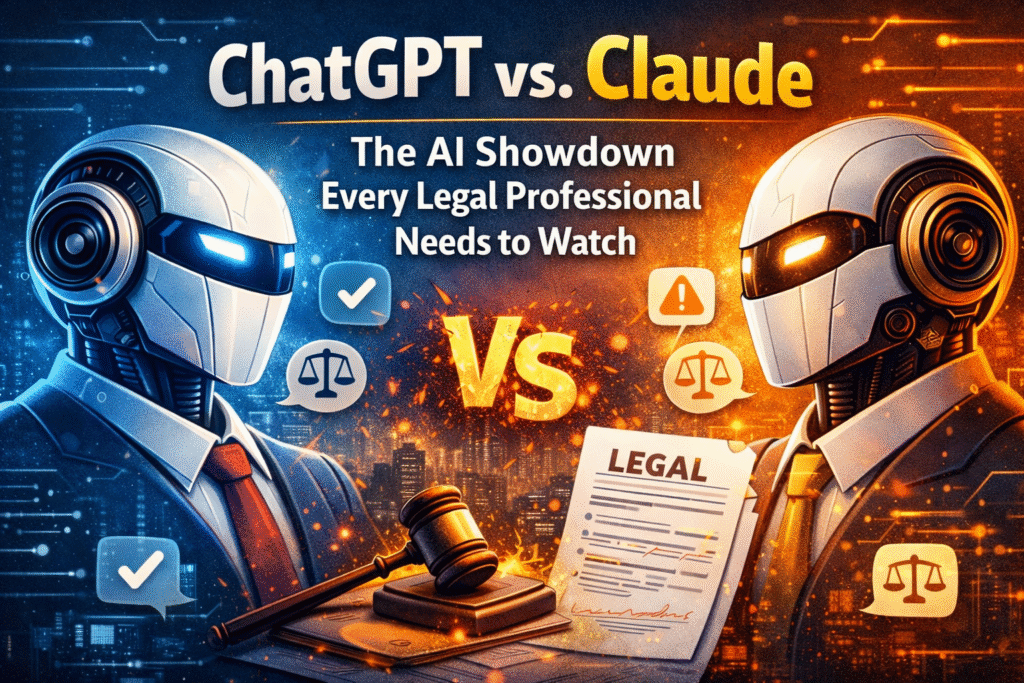
The most heated debate in legal tech right now isn’t about a landmark case or a regulatory overhaul. It’s happening in law firm break rooms, solo practitioner home offices, and BigLaw innovation committees worldwide:
“Should we be using ChatGPT or Claude?”
It sounds simple. It isn’t.
Both tools are genuinely transformative. Both have passionate advocates inside the legal profession. And both have real, practical weaknesses that could embarrass you in front of a client — or worse, before a judge.
This post cuts through the hype and gets tactical. By the end, you’ll know exactly which tool to use and when — and you’ll understand why the lawyers getting the best results are using both.
First, a Reality Check
Before we compare features, let’s be honest about something the vendors won’t tell you: neither ChatGPT nor Claude is a lawyer.
They don’t hold practising certificates. They can’t be held professionally liable. They hallucinate — sometimes confidently, sometimes catastrophically. When an AI invents a case citation and you put it in a brief (and yes, it has happened, with consequences), the bar association doesn’t discipline the chatbot.
With that said, used intelligently, these tools are nothing short of extraordinary. The gap between a lawyer who uses AI well and one who doesn’t is widening every quarter. Let’s make sure you’re on the right side of it.
Who Built These Things, and Why Does It Matter?
ChatGPT was created by OpenAI and launched in late 2022, kicking off the generative AI revolution. It’s built on GPT architecture (currently GPT-4o and more advanced variants) and was trained on a vast, broad sweep of internet text. Think of it as the polymath — deeply curious, fast, creative, and happy to pivot from drafting a client email to explaining quantum physics.
Claude was created by Anthropic, a company founded specifically around AI safety. It takes its name from Claude Shannon, the father of information theory. From day one, Anthropic’s mission shaped Claude’s design: it was built to be helpful, honest, and harmless, with a particular focus on accuracy, careful reasoning, and handling sensitive, high-stakes content responsibly. Legal work is practically in its DNA.
This philosophical difference in origin has practical consequences for how each model behaves — consequences that matter enormously in legal practice.
The Head-to-Head: What Actually Matters for Legal Work
1. Document Analysis & Context Window
This is where the difference is most stark, and where it matters most for legal professionals.
Claude wins here — and it’s not close.
Claude can process and reason across hundreds of pages of documents in a single session without losing coherence. Deposit agreements, expert reports, lengthy contracts, multi-party correspondence chains — Claude holds the full thread. It stays grounded in source material and is less likely to summarize away the clause that matters.
ChatGPT, while improved significantly, still operates with a more focused context approach. A complex, document-heavy case — think a high-asset divorce with thousands of pages of financial records — may require multiple separate sessions, creating fragmentation risk and extra work.
Bottom line for lawyers: For document review, contract analysis, deposition prep, and any task requiring you to upload and interrogate large files, Claude has a meaningful edge.
2. Accuracy and Hallucination Rates
Both models hallucinate. Neither is immune. But they hallucinate differently, and the frequency differs.
Claude was built with accuracy as a primary design goal. Its Constitutional AI framework trains it to self-correct, flag uncertainty, and avoid the kind of confident wrongness that gets lawyers in trouble. It tends to say “I’m not certain” rather than invent a plausible-sounding answer.
ChatGPT is more prone to confidently presenting incorrect information, particularly when pushed into areas at the edge of its training. The newer GPT-5 generation shows significantly fewer hallucinations than earlier versions, but the architectural emphasis has always been capability first, caution second.
Bottom line for lawyers: For any output that will be cited, filed, or presented to a client, verify everything — but start with Claude if accuracy is the priority. For exploratory brainstorming where you’re generating ideas to then verify yourself, ChatGPT’s confidence can actually be an asset.
3. Legal Research
This is nuanced territory, and real-world attorney feedback is illuminating.
ChatGPT’s Deep Research feature has drawn serious praise from practitioners. In head-to-head tests, it has produced comprehensive, well-reasoned legal memos — identifying key Supreme Court precedents and walking through federal and state law with impressive structure. Its ability to browse the web in real time means it can pull in recent developments, newly decided cases, and current regulatory guidance that Claude, without native web access, might miss.
Claude counters with superior depth on provided materials. Feed it a stack of case files and ask it to surface inconsistencies, identify key arguments, or draft an analysis — it will outperform in that closed-document environment.
Bottom line for lawyers: Use ChatGPT with Deep Research for open-ended, current legal research tasks. Use Claude when you have the source material and need deep analytical precision on what’s in front of you. For serious legal research, neither replaces Westlaw, LexisNexis, or purpose-built legal AI tools — but both dramatically accelerate your work.
4. Legal Drafting
Real attorneys are weighing in on this, and the verdict is mixed in the most useful way possible.
Many practitioners report that Claude’s output requires less editing. It tends to write with a more natural, precise tone — less verbose, more structurally sound. It doesn’t pad. It doesn’t over-explain. Several lawyers describe working with Claude as “being in dialogue with a smarter person” — the drafts feel less like machine output and more like a first pass from a strong associate.
ChatGPT, with the right prompting, is extremely capable at drafting. Its versatility shines here — it can shift register, adopt your firm’s voice, generate multiple variations of an argument, and move between formal pleading language and plain-English client communication with ease. Its custom GPTs ecosystem also allows firms to build tailored drafting tools on top of the base model.
Bottom line for lawyers: Claude for polished, accurate long-form drafting with less cleanup. ChatGPT for high-volume drafting, variation generation, and client-facing content where versatility and creativity matter.
5. Client Communication
Both tools shine here, but differently.
ChatGPT is fast, personable, and excellent at generating client-facing content at scale — personalised update emails, FAQ documents, engagement letters, website copy. It adapts tone effortlessly.
Claude excels at explaining complex legal concepts clearly and accurately. Ask it to explain a recent regulatory change’s impact on a client’s business, and it will produce a thoughtful, nuanced answer that holds up to scrutiny — not just a confident-sounding summary.
Bottom line for lawyers: Both are excellent for client communication. Use ChatGPT for volume and variety; use Claude for accuracy-critical client explanations.
6. Multimodality and Integrations
ChatGPT wins here — comprehensively.
ChatGPT is genuinely multimodal: text, images, audio, video, code execution, web browsing, file analysis. Its ecosystem of plugins, custom GPTs, and integrations with third-party tools is vast. For firms looking to build AI-enhanced workflows across CRM, document management, and practice management platforms, ChatGPT’s infrastructure is more mature.
Claude can analyse images but cannot generate them, lacks native web browsing, and has a narrower integration ecosystem — though this is evolving rapidly.
Bottom line for lawyers: If your firm is building AI-powered workflows and automations, ChatGPT’s ecosystem gives you more to work with today.
7. Data Privacy and Ethics
This is the conversation most firms are not having loudly enough.
Both OpenAI and Anthropic offer enterprise tiers with enhanced data privacy commitments. At the enterprise level, neither company claims to train on your inputs. But here is the uncomfortable truth: many legal professionals are still using free-tier or personal accounts — pasting privileged client information into consumer-grade AI tools without proper data governance.
This is a professional liability issue. Potentially a regulatory one. The SRA, the ABA, and bar associations worldwide are watching.
Claude’s Constitutional AI framework and Anthropic’s explicit safety-first positioning give many legal professionals greater comfort with sensitive content. But the tool itself is only part of the equation. The governance layer — how your firm controls what gets fed to AI, how outputs are reviewed, how interactions are logged — matters more than which chatbot you pick.
Bottom line for lawyers: Evaluate both at the enterprise level. Build a governance framework before you scale. AI governance is not an IT issue; it’s a professional responsibility issue.
The Verdict: Stop Thinking “Either/Or”
Here’s what the most sophisticated legal AI adopters have figured out:
The lawyers getting the best results aren’t loyal to one tool. They’re using the right tool for each task.
A practical framework:
| Task | Recommended Tool |
|---|---|
| Large document review & contract analysis | Claude |
| Accuracy-critical drafting (briefs, pleadings) | Claude |
| Open-ended legal research with web access | ChatGPT (Deep Research) |
| Brainstorming arguments and strategies | ChatGPT |
| Complex client explanations | Claude |
| High-volume client-facing content | ChatGPT |
| Building AI-powered firm workflows | ChatGPT |
| Sensitive document analysis (with governance) | Claude |
Three Things to Do Before You Use Either Tool in Practice
- Read your bar association’s AI guidance. Most major jurisdictions have issued guidance by now. Competency, supervision, and confidentiality obligations apply to AI-assisted work.
- Upgrade to enterprise. Free-tier accounts have no place in professional legal practice. The cost of ChatGPT Enterprise or Claude for Business is negligible compared to the liability exposure of mishandling client data.
- Build a human-in-the-loop workflow. AI drafts; the solicitor verifies. This isn’t optional — it’s the entire model. The practising certificate belongs to the human, not the chatbot.
Final Thought
The question was never really “ChatGPT or Claude?”
The real question is: how do you build an AI-augmented practice that’s faster, more accurate, and more scalable — without sacrificing the professional standards your clients and your licence demand?
The tools are extraordinarily capable. The governance is your responsibility. Get both right, and you’ll have a competitive advantage that compounds every quarter as your competitors are still debating which chatbot to try.