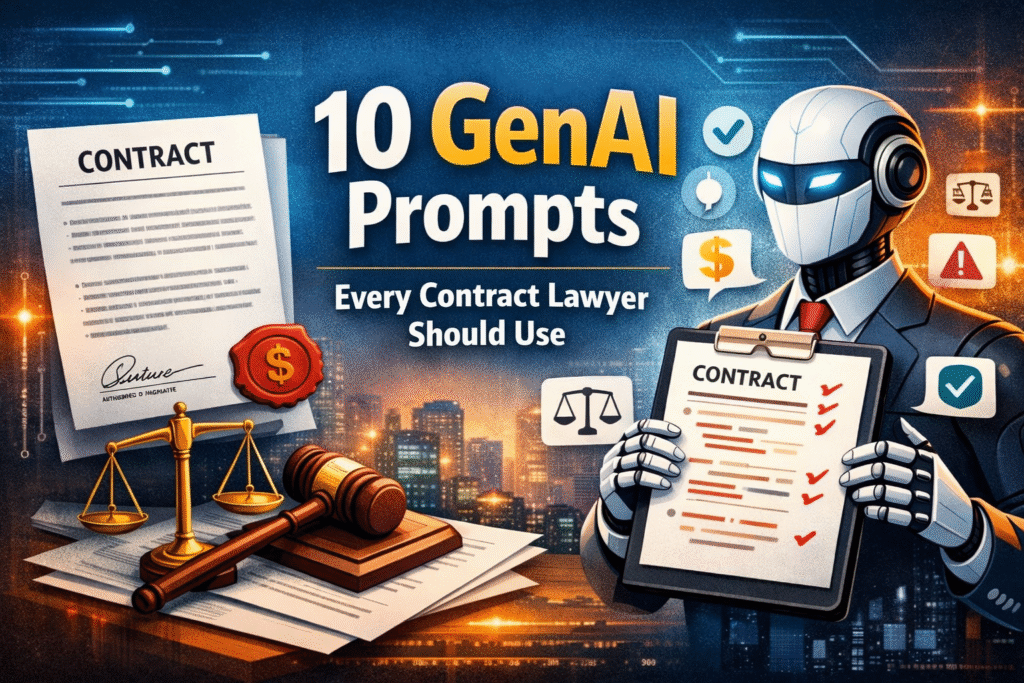
If you draft and negotiate contracts for a living, GenAI is only useful when it behaves like a disciplined junior attorney: it follows your playbook, flags real risk, and doesn’t “creatively” rewrite your deal.
The prompts below are built for US contract lawyers, drafters, and negotiators. They focus on what actually moves the needle: faster first passes, cleaner redlines, smarter fallbacks, and better negotiation posture—without inventing law or making up “market” claims.
Important: Don’t paste confidential client data unless your org has approved the tool and you understand retention/privacy settings. And never accept “market standard” assertions without checking your own precedent set.
How to use these prompts (one tweak that changes everything)
For best results, paste (1) the clause, (2) deal context, and (3) your risk posture. Where you see brackets, replace them:
- [ROLE] = Customer / Vendor / Buyer / Seller / Licensor / Licensee / Landlord / Tenant
- [DEAL TYPE] = SaaS, MSA, SOW, NDA, DPA, reseller, procurement, services, IP license, etc.
- [LAW] = New York / Delaware / California / Texas, etc.
- [RISK POSTURE] = Conservative / Balanced / Aggressive
Prompt #1: The “Clause Triage” prompt (risk rank + why it matters)
Use when: you inherit a redline and need to know what to fight about first.
Copy-paste
You are my contract triage assistant.
Deal: [DEAL TYPE]. Our role: [ROLE]. Governing law: [LAW]. Risk posture: [RISK POSTURE].
Review the clause below and produce:
- Risk rating (High/Medium/Low)
- What could go wrong (plain English, 3–5 bullets)
- Who it harms (legal, finance, ops, security, product)
- Fix options (2 alternatives: “tighten” and “fallback”)
- One-sentence negotiation justification I can use on a call
Clause: [PASTE CLAUSE]
Do not assume missing context—list unknowns first.
Why it works: Forces prioritization and gives you language you can actually say out loud.
Prompt #2: Redline generator with three fallbacks (Aggressive / Market / Concession)
Use when: you want fast markup you can refine in Word.
Copy-paste
Redline this clause for our benefit.
Deal: [DEAL TYPE]. Our role: [ROLE]. Governing law: [LAW].
Produce:
- Version A (Aggressive), Version B (Market), Version C (Concession)
- Use [brackets] for additions and
strikethroughfor deletions- For each version: 2–3 bullet rationale + what we’re giving up / protecting
Clause: [PASTE CLAUSE]
If you need context (pricing model, data type, criticality), ask first—don’t guess.
Why it works: Negotiation is about options. This gives you a ladder.
Prompt #3: “Playbookize it” (turn your precedent into rules the AI follows)
Use when: you have a preferred clause and want consistent drafting.
Copy-paste
I’m going to paste (1) the counterparty clause and (2) our preferred precedent clause.
Task: extract a drafting playbook from our precedent:
- Non-negotiables (must-haves)
- Acceptable compromises (fallbacks)
- Language patterns to preserve (defined terms, structure)
Then produce a redline of the counterparty clause that conforms to the playbook.
Output format: Playbook (bullets) → Redline (marked up).
Counterparty clause: [PASTE]
Our precedent clause: [PASTE]
Why it works: Makes the model follow your standards instead of inventing them.
Prompt #4: “Definitions & cross-references audit” (the silent deal killer)
Use when: the clause looks fine… until it doesn’t.
Copy-paste
Audit this clause for defined terms and cross-references.
Provide:
- Defined terms used but not defined (list)
- Defined terms defined but unused (list)
- Cross-references that are missing/ambiguous (list)
- Inconsistencies (time periods, notice methods, dollar caps, standards like “commercially reasonable”)
- Clean-up rewrite that fixes only the issues above (do not change business terms).
Clause + related definitions (if any): [PASTE]
Why it works: Catches the stuff that causes disputes later.
Prompt #5: “Negotiation script” (email + call track + fallback triggers)
Use when: you need a crisp position for procurement or a tough opposing counsel.
Copy-paste
Create a negotiation script for this clause.
Deal: [DEAL TYPE]. Our role: [ROLE]. Risk posture: [RISK POSTURE].
Provide:
- 90-second call track (what I say)
- Likely pushbacks (5) + responses (5)
- Concession ladder: what we can trade for what (3 trades)
- “Walk-away” triggers (2–4)
Clause: [PASTE CLAUSE]
Why it works: It turns drafting into leverage and strategy.
Prompt #6: Liability package builder (cap + carve-outs + damages + indemnity alignment)
Use when: the deal’s risk allocation is drifting across sections.
Copy-paste
Build a consistent liability framework for this deal and align the clauses.
Deal: [DEAL TYPE]. Our role: [ROLE]. Governing law: [LAW].
Goals: cap at [X], exclude consequential damages with standard carve-outs, align indemnity with cap/carve-outs, handle data/security if applicable.
Output:
- Proposed “liability architecture” (cap, exclusions, carve-outs, super-cap if any)
- Clause-by-clause fixes (limitation of liability, indemnity, termination, confidentiality, DPA/security)
- One clean consolidated Limitation of Liability clause (redline format)
Current relevant clauses: [PASTE ALL RELEVANT]
If something conflicts, flag it explicitly.
Why it works: Stops the classic problem where indemnity says one thing and LoL says another.
Prompt #7: Confidentiality clause that matches the deal (not generic boilerplate)
Use when: NDAs and confidentiality sections are inconsistent or over/under-scoped.
Copy-paste
Draft / revise the confidentiality clause for [DEAL TYPE] where we are [ROLE].
Parameters:
- Confidential Information scope: [narrow/balanced/broad]
- Term: [X years / perpetual for trade secrets]
- Permitted disclosures: affiliates, contractors, auditors, legal, court order
- Security standard: [reasonable / ISO-like / specific controls]
Output:- Clause (clean)
- 5 risk notes + optional enhancements
- 3 fallback versions (Aggressive/Market/Concession)
Existing clause (if revising): [PASTE]
Why it works: Confidentiality should reflect data sensitivity and business reality.
Prompt #8: “Data + Security addendum sanity check” (SaaS and services deals)
Use when: the DPA/security language is too vague or too punitive.
Copy-paste
Review this data/security language for a [SaaS/services] deal. Our role: [Customer/Vendor].
Identify:
- Missing essentials (access controls, encryption, incident response, subcontractors, audits, data return/deletion)
- Overreaches (unbounded audit rights, strict liability, unrealistic timelines)
- A balanced rewrite (clean + fallback)
- Incident clause: propose notice timeline and content that’s defensible
Text: [PASTE DPA/SECURITY TERMS]
Do not cite laws; focus on contract language and operational feasibility.
Why it works: Keeps security terms enforceable and realistic.
Prompt #9: “Scope of work / SOW clarity” (prevent change-order wars)
Use when: services deals are vague and destined to explode.
Copy-paste
Rewrite this SOW to reduce ambiguity and change-order disputes.
Provide:
- Deliverables (with acceptance criteria)
- Timeline + dependencies (what we need from them)
- Assumptions + exclusions
- Change control process (trigger events + pricing/time impact language)
- A short “anti-scope-creep” clause
Current SOW: [PASTE]
Keep it commercially reasonable and US-style contracting.
Why it works: Most services disputes are just unclear scope.
Prompt #10: “Clean vs redline dual output” (so you can drop it into the doc immediately)
Use when: you need both the markup and the polished clause.
Copy-paste
For the clause below, generate two outputs:
- A redline using [brackets] and
strikethrough- A final clean version incorporating the changes
Also include:
- 5 bullets explaining what changed and why (risk/negotiation)
Context: Deal [DEAL TYPE], role [ROLE], law [LAW], risk posture [RISK POSTURE]
Clause: [PASTE]
Why it works: Saves you the annoying step of manually “accepting” changes to see the clean result.
Bonus: Two “power modifiers” you can add to any prompt
Modifier A: Make it conservative and non-hallucinatory
Add this to the end of any prompt:
If information is missing, say “Unknown” and ask questions. Do not invent facts, definitions, citations, or “market” claims.
Modifier B: Make it negotiation-ready
Add this to the end of any prompt:
Include (1) the business impact in one sentence, (2) a counterparty-friendly explanation, and (3) a concession ladder.
A practical workflow that makes these prompts feel like a superpower
If you want GenAI to be reliable in contracting, use this sequence:
- Triage the clause (Prompt #1)
- Generate options (Prompt #2)
- Align to your playbook (Prompt #3)
- Audit definitions/cross-references (Prompt #4)
- Prepare the negotiation script (Prompt #5)
- Package liability/security where needed (Prompts #6 and #8)
That’s it. You’ll be faster, more consistent, and less likely to miss the stuff that becomes a dispute.
Copy-paste mini template (use this in any contract prompt)
If you only save one thing, save this:
Deal type: [ ] | Our role: [ ] | Law: [ ] | Risk posture: [ ]
Business must-haves: [ ]
Non-negotiables: [ ]
Concessions we can make: [ ]
Clause text: [paste]
Instructions: Do not guess. Ask clarifying questions. Provide 3 fallback options.